
The Physical Limits of AI: Power, Land, and Infrastructure at Scale
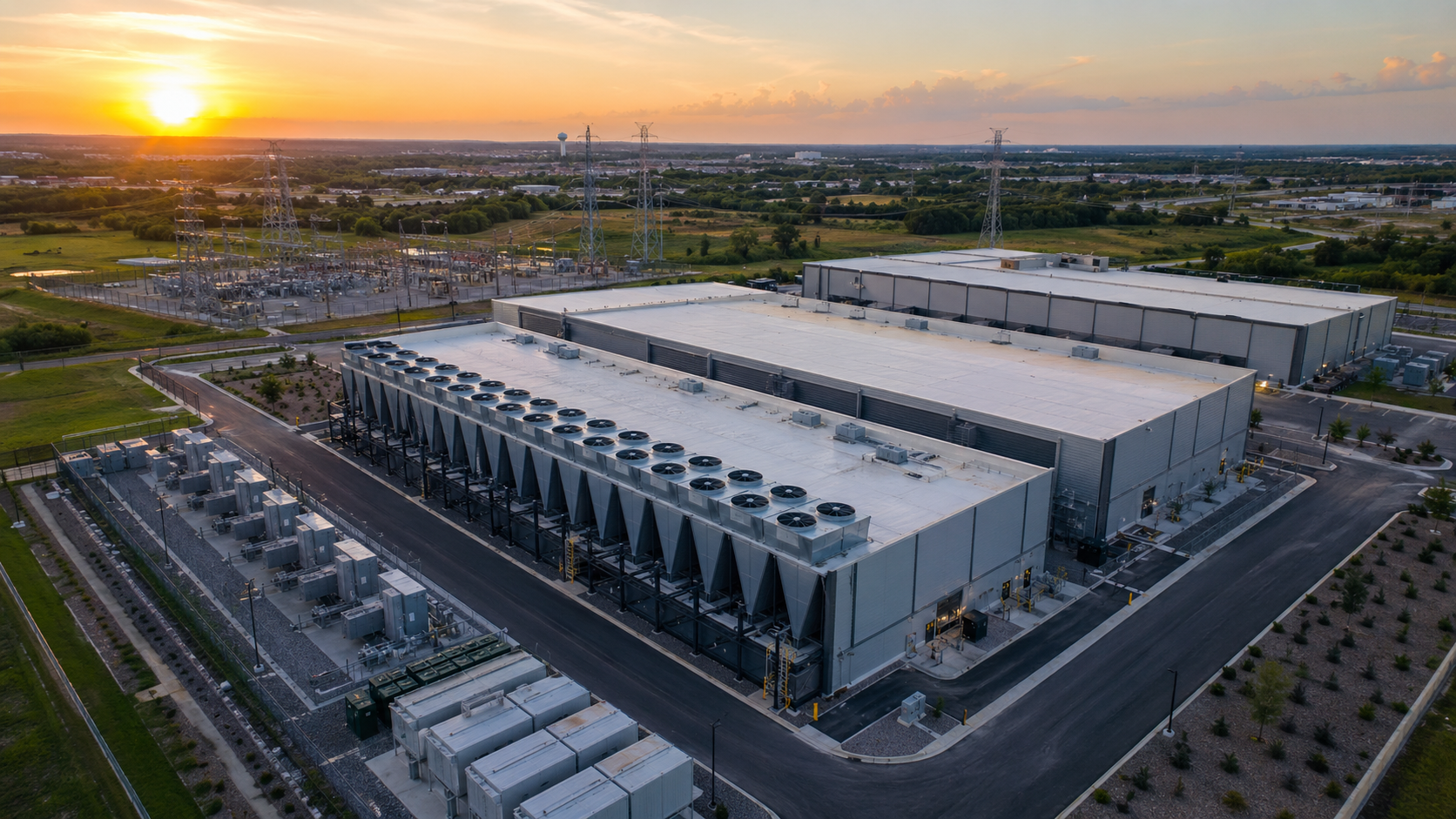
The artificial intelligence boom is often framed as a software revolution, but that framing misses the most important story unfolding beneath it. AI is not just code—it is concrete, steel, transmission lines, substations, and water systems operating at unprecedented scale. Every query, every model training run, and every generated image is supported by a rapidly expanding physical footprint that is reshaping land use, power infrastructure, and industrial development across the United States.
What appears to be an instant digital interaction is, in reality, a high-intensity industrial process. The moment an AI request is triggered, it activates thousands of synchronized processors operating in parallel across dense server clusters. These clusters demand enormous amounts of electricity delivered with extreme precision and reliability. The scale of this demand is no longer incremental—it is exponential, and it is forcing a complete rethinking of how infrastructure is planned, financed, and deployed.
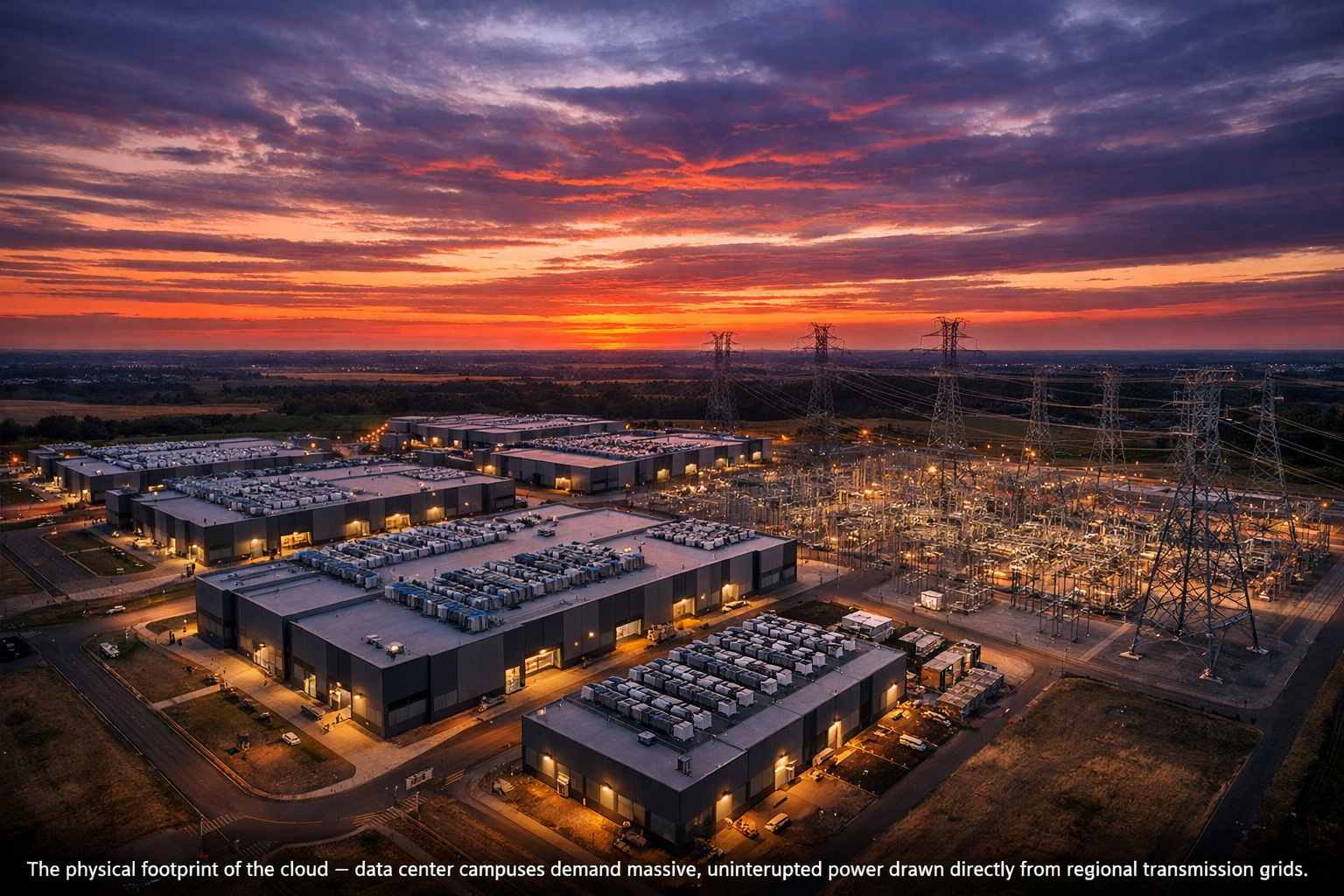
Data centers already consume a meaningful share of total electricity, but the trajectory is what matters. Within the next decade, AI-driven demand could push data center consumption into double-digit percentages of total grid load. In key markets, the concentration is even more dramatic, with certain regions facing the possibility that data centers alone could dominate local electricity usage. This is not a distant scenario—it is actively shaping utility planning, interconnection queues, and land acquisition strategies today.
The shift is driven not just by volume, but by the nature of AI computation itself. Traditional cloud workloads are relatively distributed and resilient, but AI workloads are tightly coupled and highly synchronized. This creates what engineers describe as a “failure amplification” problem: if one component fails during a training run, the entire system may need to restart, wasting significant energy and time. As a result, reliability requirements are escalating alongside power demand, further increasing infrastructure complexity.
At the facility level, the transformation is even more striking. Legacy server racks that once consumed modest amounts of power are being replaced by high-density configurations capable of drawing hundreds of kilowatts—and in some cases approaching megawatt-scale loads per rack. This level of density fundamentally alters everything from electrical design to thermal management. Traditional assumptions about spacing, airflow, and redundancy no longer apply.
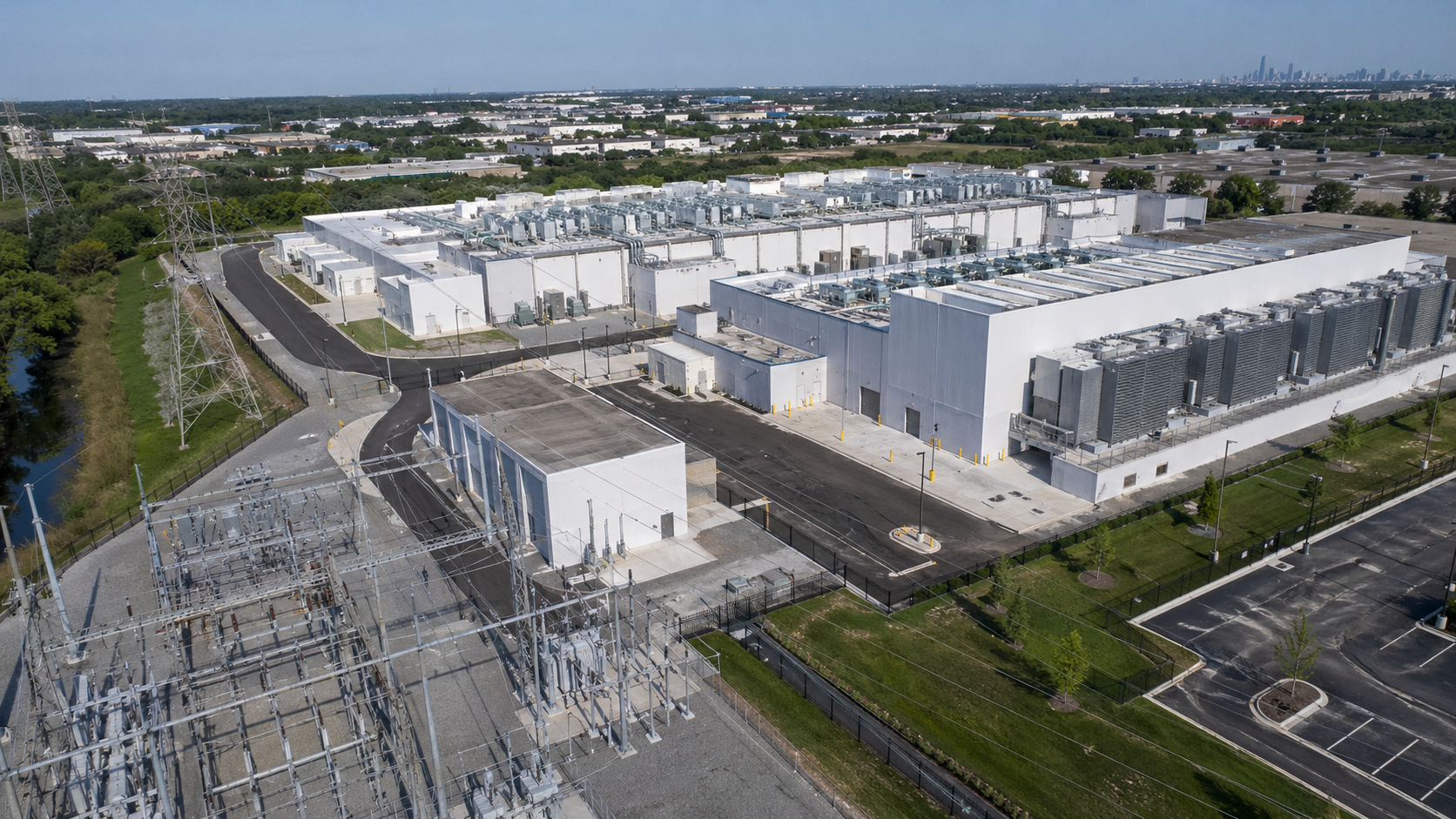
Power delivery systems are evolving in response. Higher voltage architectures are being adopted to reduce current and mitigate heat losses, while advanced semiconductor technologies enable faster and more efficient power conversion. At the same time, the supporting infrastructure surrounding these systems is expanding. Power equipment that once fit neatly within server racks is now being externalized into adjacent units, increasing the physical footprint of each deployment.
This expansion does not stop at the building edge. The interaction between data centers and the electrical grid is becoming more dynamic and more complex. Sudden spikes in demand cannot always be absorbed instantly by local utilities, requiring facilities to incorporate on-site energy storage and buffering systems. Batteries, capacitors, and backup generation are no longer just emergency systems—they are active components of daily operations, helping to stabilize both the facility and the surrounding grid.
Cooling has emerged as an equally critical constraint. As power density increases, so does heat generation, and the industry is rapidly moving beyond traditional air-based systems. Liquid cooling is becoming standard, with direct-to-chip solutions delivering coolant precisely where it is needed. More advanced approaches, including micro-scale cooling embedded within chips and optical data transfer technologies, are being developed to further reduce thermal loads.
However, these innovations introduce new challenges at the community level. Water usage, in particular, has become a point of concern. Early cooling approaches that relied on evaporative systems drew significant volumes of water, creating tension in water-constrained regions. In response, the industry is shifting toward closed-loop systems that minimize consumption and reduce environmental impact. This shift is not optional—it is essential for long-term viability.
All of these factors converge on one critical reality: AI infrastructure is no longer just a technology problem. It is a land use problem, a power generation problem, and a resource allocation problem. Developers must secure sites with access to high-capacity transmission, proximity to substations, and sufficient space to accommodate evolving building designs. At the same time, they must navigate regulatory frameworks, community concerns, and long-term uncertainty about technology requirements.
This uncertainty is perhaps the most challenging aspect of the current moment. The pace of innovation in AI hardware is so rapid that facilities risk becoming obsolete within a few years if they are not designed with flexibility in mind. As a result, a new development philosophy is emerging—one that prioritizes modularity, scalability, and adaptability over rigid optimization.
Ultimately, the trajectory of AI infrastructure will be defined by physical limits. Power availability, thermal management, and resource constraints will shape what is possible far more than software breakthroughs alone. The next phase of innovation may depend less on increasing raw computational power and more on improving efficiency—delivering the same outcomes with fewer resources.
For land developers, utilities, and infrastructure investors, this shift represents both a challenge and an opportunity. The demand for strategically located, infrastructure-ready sites is accelerating, and those who can align land, power, and design will play a central role in enabling the next generation of AI.
Share this article
Follow us
Latest articles
National Land Developers, LLC
609 E. Baltimore Pike
Media, PA 19063
Map & Directions