
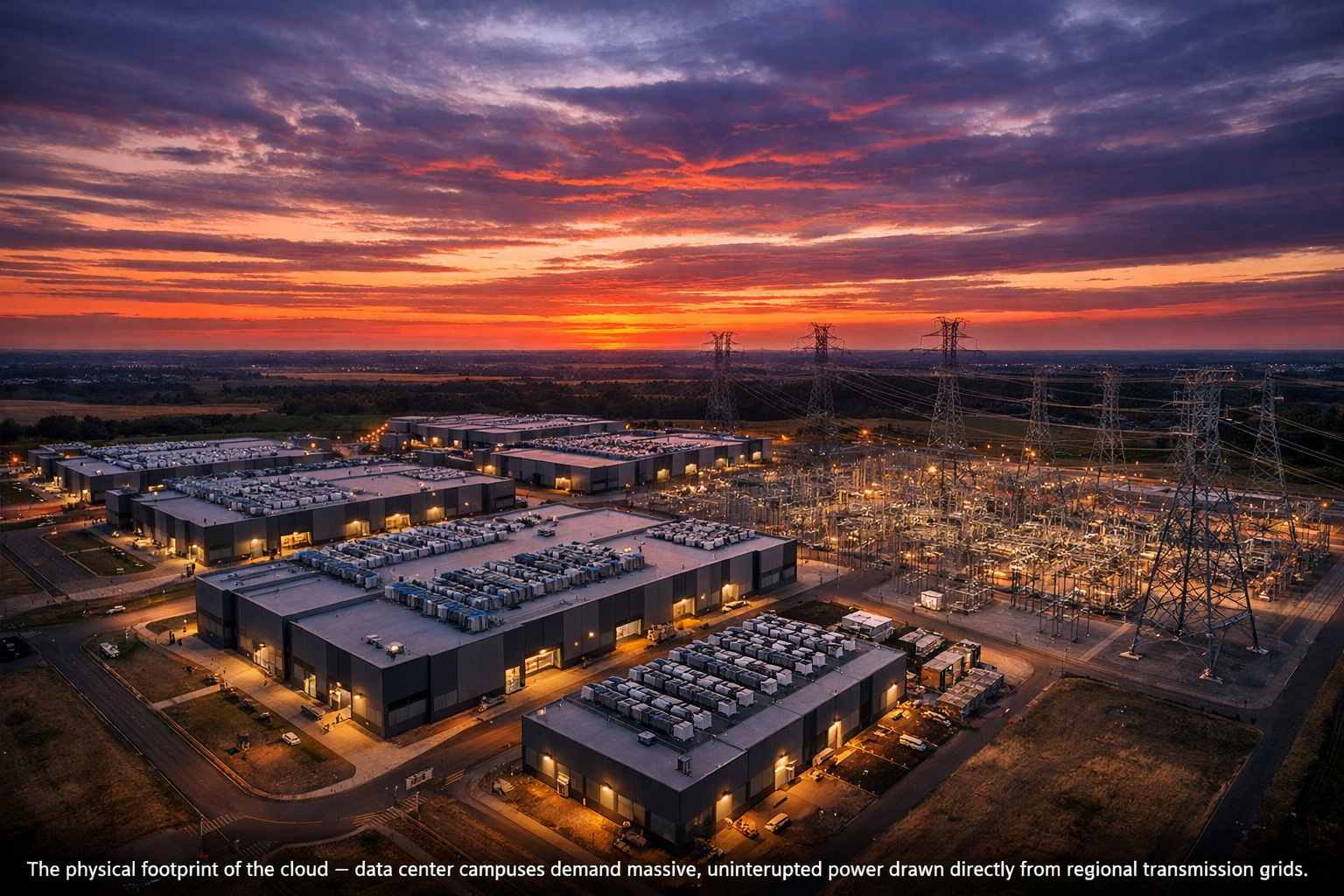
The Grid Cannot Keep Up: How America’s Power Infrastructure Became the Biggest Threat to the AI Revolution
America's aging power grid is collapsing under the weight of exponential AI and data center demand. With a grid bottleneck forecast for 2026 and transformer lead times stretching four years, the race to secure power is now the defining competitive challenge in the technology sector -- and it is reshaping where data centers get built.
When people imagine the obstacles standing between today and a fully AI-powered future, they tend to picture semiconductor shortages, export controls on advanced chips, or gaps in software capability. The reality is far more physical. The single most consequential constraint on the expansion of artificial intelligence right now is not a chip. It is not code. It is a rusting, overloaded, underfunded electrical grid that was never designed to carry the weight now being placed upon it.
The February 2025 technical report from the Western Electricity Coordinating Council (WECC), combined with market analysis from Enki AI and a July 2025 brief from the Bank of America Institute on small modular reactors, collectively paint a picture of an infrastructure system buckling under demand that has no historical precedent. What follows is a clear-eyed look at what the data shows, what it means for land, power, and site selection, and why the geography of the internet itself is being redrawn in real time.
The Scale of the Demand Surge
For decades, utility companies operated with a comfortable planning model. Load growth was predictable, incremental, and spread across millions of residential and commercial customers whose habits changed slowly. Grid planners could forecast five years out with reasonable confidence and expand capacity steadily to match. That model is now obsolete.
The WECC report documents a surge in what the industry calls large loads — single facilities or campuses drawing extraordinary amounts of power from the grid at a single point of interconnection. Historically, these were uncommon. Today, they are arriving in waves. Nationwide, grid planners have nearly doubled their five-year load growth forecasts over the course of a single year, revising projected growth from 2.6 percent to 4.7 percent. In the western United States alone, demand is expected to spike 20 percent over the next decade, rising from 164 gigawatts in 2025 to over 193 gigawatts by 2034.
Data centers are the dominant force driving this. According to WECC survey data, data centers account for 78 percent of the large load interconnection queue across the surveyed utility area. But they are not the only factor. Cryptocurrency mining operations, hydrogen electrolyzers, industrial manufacturing expansions, electrified heating systems, and the aggregate impact of millions of electric vehicle charging installations are all scaling simultaneously, all drawing from the same local substations.
The statistic that most clearly illustrates the severity of the situation involves just ten utility respondents surveyed by WECC. The total size of new large-load projects waiting in their interconnection queues is 44,650 megawatts. Their entire current system peak demand — every home, business, and industrial facility they already serve — is 48,425 megawatts. The line of new projects waiting to be connected requires nearly as much electricity as those utilities currently generate for everyone they already serve. At a standard conversion of approximately 800 average homes per megawatt, 44,000 megawatts represents the power equivalent of 35 million new homes. Utilities are being asked to effectively build a second parallel grid while operating the first one.
The Bottleneck Is Physical, Not Digital
Between 2021 and 2024, the primary constraint for data center developers was the supply of IT hardware. Chips and servers had lead times stretching to 52 weeks. That challenge, severe as it was, belonged to the category of manufacturing problems — problems that can be solved by building more factories and scaling production lines.
The bottleneck that emerged from 2025 onward is categorically different. Enki AI describes this as a maturity mismatch: the constraint has migrated from the server rack to the utility substation. The limiting factor is now the heavy electrical infrastructure required to deliver power to the building, and that infrastructure cannot be manufactured faster by investing more capital.
High-voltage transformers are the clearest example. These are massive, custom-engineered devices that step down power from transmission lines to levels a data center can actually use. They require specialized copper windings, heavy steel cores, and skilled labor. They are not catalog items. Lead times for high-voltage transformers now run two to four years. If a utility needs to construct new high-voltage transmission lines to bring additional power to a region, the timeline extends to a decade or more, encompassing permitting, environmental review, land acquisition, and physical construction.
Against that backdrop, Enki AI projects a compound annual growth rate of 15 percent in U.S. data center power demand through 2030. By that year, data centers alone are expected to consume 8 percent of all electricity generated in the United States. Gartner estimates that by 2027, 40 percent of AI data centers will face operational constraints caused entirely by power shortages. The building is finished. The servers are installed. The power simply cannot be delivered.
Power Availability Is Reshaping Site Selection
The practical consequence of this bottleneck is a forced geographic migration that is visibly changing where large-scale data center development occurs. For years, the preferred locations were established technology corridors — Northern Virginia, the San Francisco Bay Area, Phoenix, Dallas. These markets offered dense fiber networks, mature labor pools, favorable tax environments, and proximity to tech ecosystems.
Developers are abandoning those markets now, not by preference but by necessity. The interconnection queues in prime technology markets are years long. The spare capacity that once made those regions attractive has been consumed. In their place, secondary and tertiary markets are receiving billion-dollar investments for one reason: a substation with available megawatts.
Rural Midwestern locations, small towns adjacent to aging industrial substations, sites near retired power plants with existing grid connections — these are now serious competitive candidates for hyperscale development. The search for accessible power is dictating the physical geography of digital infrastructure in a way that has no precedent. Fiber connectivity, which was once the primary infrastructure prerequisite, is now secondary. Power comes first. If a site cannot obtain a utility commitment for sufficient capacity within a timeline compatible with project economics, it will not be developed regardless of its other attributes.
For land owners and developers, this dynamic creates both risk and opportunity. Sites with existing substation access, proximity to transmission infrastructure, or demonstrated available capacity have acquired a category of value that did not exist five years ago. Sites in constrained markets that appeared highly desirable based on traditional criteria now carry significant development risk.
Tech Giants Move Upstream Into Energy
When the largest and most heavily capitalized technology companies in the world concluded that public utility timelines were incompatible with their growth requirements, they did not wait. They began building their own power supply chains.
The Enki AI report highlights one landmark example: Google, Intersect Power, and TPG formed a $20 billion clean energy fund. This is not a corporate sustainability initiative or a purchase of renewable energy credits. It is a vertically integrated strategy in which the technology company finances and develops its own generation assets in parallel with its data center buildout. The explicit goal is to reduce dependence on public utility interconnection timelines by owning the power source directly.
This pivot is reflected in capital expenditure patterns across the sector. Data center capital expenditure is projected to reach $377 billion by 2026. A material portion of that capital is not being allocated to computing hardware. It is being spent to secure the energy generation required to power that hardware. The infrastructure investment has moved upstream from the server room to the power plant.
The energy requirement driving this shift is not flexible. AI model training involves continuous, uninterrupted mathematical computation that runs for weeks or months. These workloads cannot tolerate power intermittency. Solar and wind generation, while cost-effective for many applications, are fundamentally intermittent and require enormous land footprints to achieve gigawatt-scale output — footprints that conflict with the need to locate generation physically close to the data center to avoid building new transmission lines. Technology companies need power that is always on, carbon-free to satisfy climate commitments, and compact enough to site adjacent to the compute campus.
The Case for Small Modular Reactors
The Bank of America Institute’s July 2025 brief on small modular reactors (SMRs) addresses what appears to be the only technology that simultaneously satisfies all three of those constraints. An SMR is an advanced nuclear fission reactor designed not as a bespoke, site-specific mega-project but as a standardized, factory-manufactured module. Individual units range from 20 to 300 megawatts of capacity, compared to the 1,000-plus megawatts of a traditional plant.
The manufacturing model changes the economics and the timeline. Because SMR components are standardized, they are assembled in controlled factory environments using production-line techniques, then transported to the installation site by truck or rail. This approach reduces construction timelines from the 6 to 10 years typical of traditional nuclear plants to a projected 3 years or fewer for SMR installations. The capital cost profile is also fundamentally different because the factory model allows economies of serial production rather than the cost overruns associated with first-of-a-kind field construction.
From a safety standpoint, SMR designs incorporate passive safety systems that rely on natural physical phenomena rather than active mechanical intervention. If an SMR loses all external power, gravity drops control rods into the core to halt the reaction, and natural thermal convection circulates coolant through the containment vessel without electric pumps. The reactor can shut itself down and cool indefinitely without human action.
The geographic flexibility of SMRs is particularly significant from a land and site selection perspective. The small footprint and reduced exclusion zone requirements allow SMRs to be sited at locations that would be impractical for traditional plants. The Bank of America brief specifically notes that retired coal plant sites — which already have high-voltage transmission connections in place — are well suited for SMR installation. So are large industrial campuses and, critically, hyperscale data center sites. Placing SMR capacity directly adjacent to the compute load eliminates the need for new transmission infrastructure entirely.
The fuel technology enabling this flexibility is high-assay low-enriched uranium (HALEU), enriched to between 5 and 20 percent compared to the 3 to 5 percent used in traditional commercial reactors. The higher energy concentration allows for a smaller reactor core and a refueling cycle of 3 to 7 years rather than the 18-month cycle of conventional plants.
The Obstacles Ahead
The case for SMRs as the structural solution to the grid bottleneck is compelling on technical grounds. The barriers to realization are real and should not be understated.
The HALEU fuel supply chain currently depends on a single commercial production facility worldwide. Naval and research applications historically consumed all enriched uranium at that concentration, so no commercial-scale fuel supply chain exists yet for a large fleet of SMRs. Mass deployment of factory-built reactors is not feasible without a corresponding expansion of fuel manufacturing capacity.
The workforce pipeline presents a parallel constraint. Between 2012 and 2022, the number of nuclear engineering graduates in the United States fell by 25 percent. The existing workforce is aging. Universities have not yet responded to changed demand signals. Building and operating a new generation of reactors requires a specialist workforce that does not currently exist at the required scale.
Regulatory timelines have historically been the most cited barrier to nuclear development. The Nuclear Regulatory Commission’s approval process was designed for large, bespoke traditional plants and routinely spans 5 to 10 years. As of the writing of the Bank of America brief, only one SMR design held full NRC approval in the United States, and the developer of that design did not plan to commercialize it.
The regulatory environment is, however, in active flux. On May 23, 2025, executive orders were signed directing acceleration of U.S. nuclear plant construction and streamlining of the NRC approval framework. The Department of Energy is co-funding commercial SMR development through the Advanced Reactor Demonstration Program. Globally, over 80 SMR designs are currently in development. Industry expectations center on generation 3.5 designs using proven light-water reactor technology reaching commercial deployment ahead of more experimental fourth-generation concepts. The Bank of America brief characterizes 2025 as a significant inflection point for the regulatory and policy environment surrounding nuclear energy.
Why This Matters
The power grid crisis affecting AI data center development is not an abstract industry problem. It is a structural shift in how and where large-scale infrastructure gets built, and it has direct implications for land, utilities, site selection, and the long-term value of power-advantaged real estate.
Sites with direct substation access, existing transmission interconnections, or proximity to generation assets are no longer evaluated primarily as real estate. They are evaluated as energy assets. The developers, hyperscalers, and capital allocators building the infrastructure layer of the AI economy are making location decisions based on a single question: can this site get power, in the volume required, within a timeline that supports project viability?
The migration of data center development from established technology markets to secondary and rural locations will continue as long as grid capacity in primary markets remains constrained. The emergence of on-site nuclear generation as a viable alternative to public utility interconnection will further decouple infrastructure location decisions from the existing grid map. Sites that can host generation alongside compute — whether through SMRs, advanced gas peakers, or other baseload technologies — will represent a structurally superior category of development asset.
The digital revolution runs on physical infrastructure. Power is that infrastructure’s foundation. Understanding where power can be secured, in what volumes, on what timelines, and at what cost is now a core competency for anyone involved in the land and development markets that serve the technology sector.