
The Hidden Weight of the Cloud: How AI Is Driving a Global Infrastructure Crisis
AI may feel weightless, but every search, prompt, and generated image relies on a rapidly expanding physical network of data centers, substations, transmission lines, and power plants. Here’s why the future of AI is becoming a race for land, energy, and infrastructure.
We talk about “the cloud” as though it lives somewhere above us—light, invisible, and frictionless. It is one of the most effective metaphors in modern business. Save a file to the cloud, stream a movie, run a workflow, generate an AI summary, and it all feels detached from the physical world.
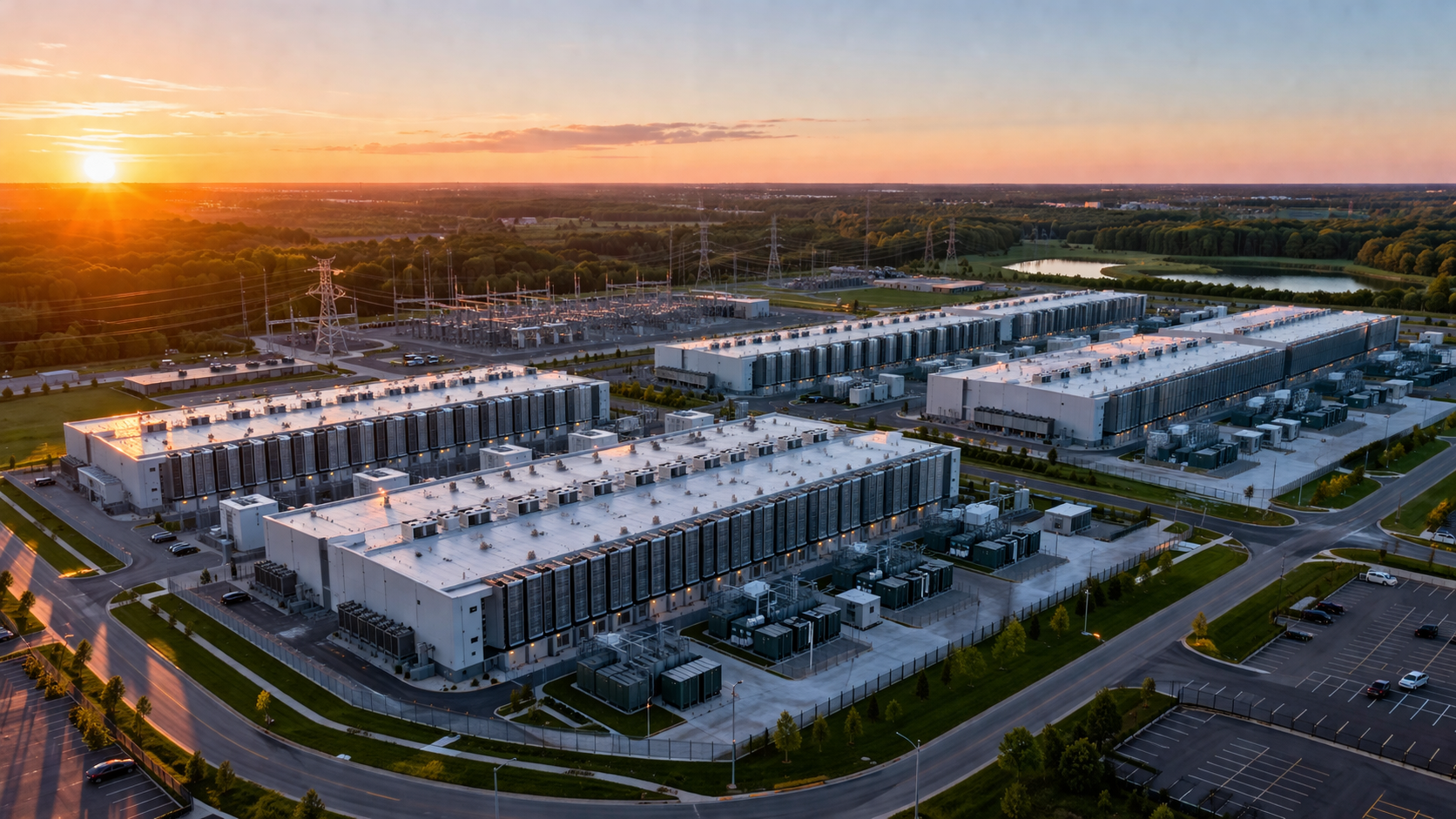
But the cloud is not weightless. It is one of the heaviest forms of infrastructure humanity has ever built. Behind every digital action sits an industrial landscape of land, concrete, steel, substations, copper, transformers, backup systems, and an enormous, uninterrupted flow of electricity. And as artificial intelligence accelerates, that hidden physical footprint is becoming impossible to ignore.
The transcript provided for this post points to a simple but increasingly urgent reality: the AI boom is no longer just a software story. It is a land-and-power story. The next phase of digital growth will depend less on sleek interfaces and more on whether regions can permit, power, and connect the industrial real estate required to support it.
The cloud has a geography—and it is tightening
Digital infrastructure is intensely concentrated in a handful of markets. Northern Virginia remains the global capital of data centers, with more than 2 gigawatts of available supply devoted to these facilities. That level of concentration is remarkable on its own, but the more important point is what it implies: AI demand is not floating abstractly through the economy. It is landing in very specific places, where physical systems are under visible stress.
In constrained markets, the pressure is even more pronounced. Singapore, for example, has become a symbol of what happens when digital demand collides with limited land and limited power. Vacancy is exceptionally tight, available capacity is scarce, and rental rates reflect the cost of building in a geography where expansion is no longer simple. Even when demand is global, the infrastructure required to satisfy it is stubbornly local.
That dynamic is pushing users and operators toward markets that still offer developable land and faster access to power. Dallas–Fort Worth has emerged as one of the clearest examples. Its surge is not just about economics; it is about infrastructure optionality. Regions that can move faster on interconnection, substations, transmission, and utility coordination are becoming magnets for digital investment.
Why land alone is not enough
From a distance, a data center may look like a simple industrial building: a large shell on a large site. But the building itself is often the easy part. The hard part is integrating a massive, continuous electrical load into the local grid without destabilizing it.
Residential and commercial demand rises and falls throughout the day. Data centers do not behave that way. They draw power continuously and at scale, requiring utilities to think differently about reliability, baseload supply, voltage management, and transmission capacity. In many cases, the true bottleneck is not the parcel. It is the ability to energize the parcel.
That is why communities and governments are reacting in more visible ways. Some markets have slowed or paused development. Others are requiring operators to redesign systems around heat reuse, water constraints, or stricter utility integration. The message is clear: digital growth now has to negotiate with physical planning realities, from zoning and permitting to transmission corridors and community impact.
AI changed the equation
For years, data center demand grew steadily while efficiency gains kept broader power consumption relatively manageable. Generative AI has disrupted that balance. A traditional search query and an AI-generated response are not the same computational event. One largely retrieves information. The other actively generates it across extremely large models in real time. That difference matters, because it turns software ambition into electrical demand.
What makes this especially important is that newer AI hardware is both more efficient and more power-dense. In practical terms, each system can perform dramatically more work than the last generation—but it also pulls more power at the rack level. That combination does not reduce infrastructure pressure. It often intensifies it.
This is the classic logic of induced demand. When the cost per unit of computation falls, companies do not simply save money and stop. They scale up usage. They deploy more models, train larger systems, process more queries, and push AI deeper into their operations. Efficiency makes broader adoption economically attractive, and broader adoption drives total energy consumption higher.
The grid is becoming the real bottleneck
The United States power system spent much of the last decade in a low-growth environment. Utilities were accustomed to modest overall demand growth, even as devices proliferated. AI is changing that trajectory. As power-hungry facilities come online, regions are being asked to deliver a level of load growth that many had not planned for just a few years ago.
In major data center clusters, this is no longer theoretical. Utilities are confronting rising interconnection queues, overloaded substations, transformer shortages, and the need for major transmission upgrades. In some cases, even large users have had to wait because the supporting infrastructure simply was not ready.
This is where the digital narrative breaks down. A single AI prompt may feel instantaneous to the user, but the ability to serve that prompt depends on a physical chain that stretches far beyond the server hall: generation, high-voltage transmission, substations, local distribution, backup systems, cooling infrastructure, and the land to host all of it. The true challenge is not whether AI can create demand. It already has. The challenge is whether the built environment can keep pace.
What this means for industrial land and utility infrastructure
For developers, utilities, and site selectors, the implications are profound. The most valuable industrial sites are not merely large or well located. They are the sites with a credible path to power. That means access to transmission, utility cooperation, substation capacity, resilient water and cooling options where required, and a permitting environment that can support large-scale infrastructure.
It also means the boundary between “digital” real estate and “traditional” infrastructure is disappearing. Data centers increasingly sit inside a much larger ecosystem that includes transmission lines, substations, gas generation, renewable integration, and industrial support networks. The winners in this cycle will be the markets that understand that relationship and plan for it early.
For communities, the conversation is becoming more strategic. The question is no longer whether digital infrastructure matters. It clearly does. The real question is what kind of infrastructure growth a region wants, what tradeoffs it is willing to make, and whether it has the land-use and utility framework to capture the upside without overwhelming existing systems.
The next AI race may be a race for energy
There is a tendency to frame AI competition as a contest of models, chips, and software talent. Those factors matter. But the transcript behind this article highlights a deeper constraint: physical capacity. If demand for AI tools keeps rising and major firms keep spending to stay competitive, the limiting factor may not be code. It may be energy, interconnection, materials, and the time required to build.
That shifts the conversation in a significant way. The regions best positioned for the next wave of AI growth may be the ones that can assemble power, land, and infrastructure faster than everyone else. In that world, industrial development, utility planning, and energy strategy become central to digital competitiveness.
The cloud was never truly invisible. AI is simply forcing us to see it. Every generated answer, every automated workflow, and every model deployment depends on a real-world foundation of land, wires, steel, and power. As adoption accelerates, the defining question may no longer be what AI can do. It may be whether we can build enough of the physical world to support what comes next.

