
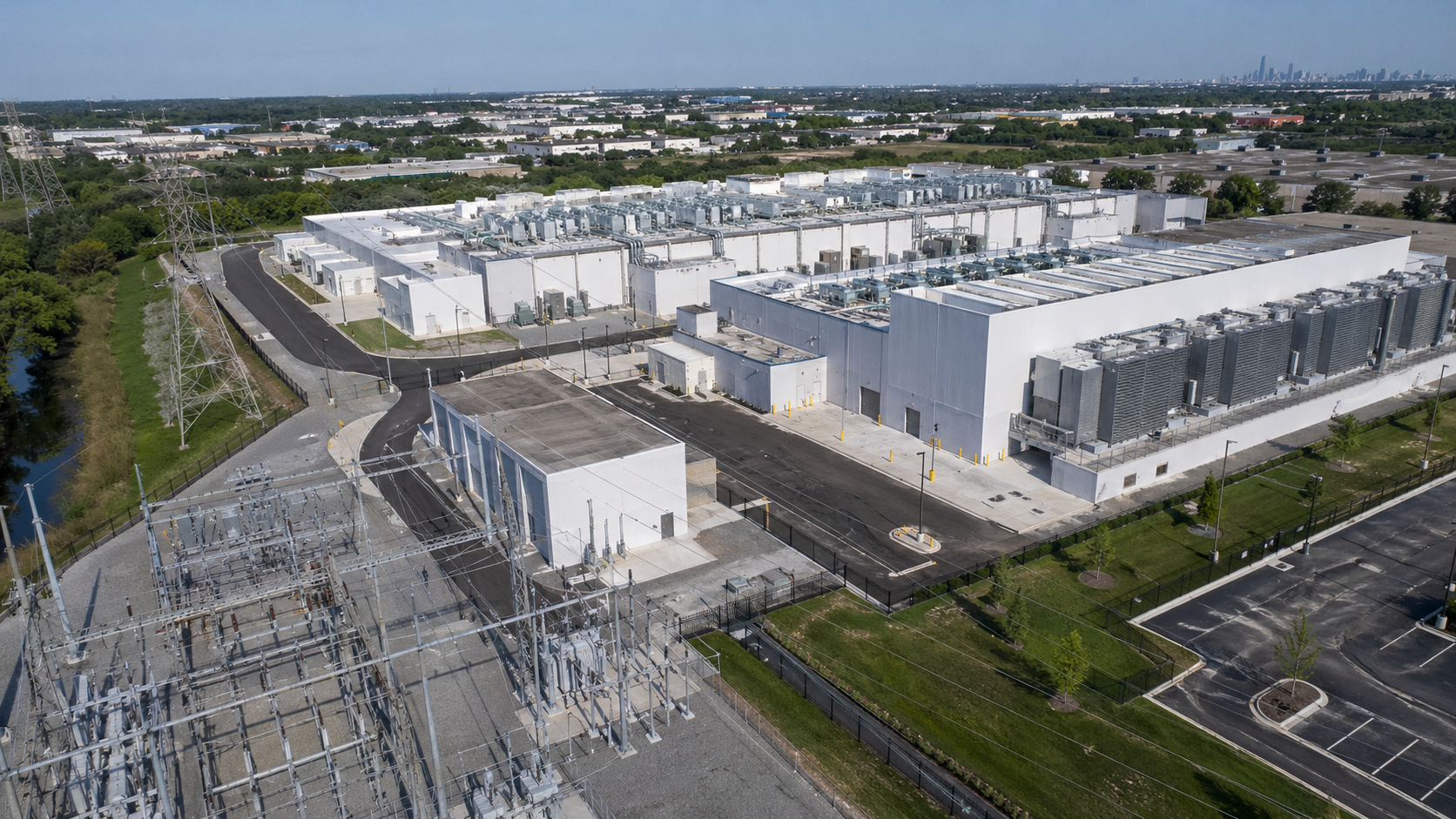
Inside the Electrical Backbone of Hyperscale Data Centers
[...]
The modern digital economy is often described as weightless—existing somewhere in “the cloud.” In reality, it is anything but. Every search query, financial transaction, streamed video, and AI workload is anchored to massive, industrial-scale infrastructure that consumes extraordinary amounts of power. At the center of this system lies the data center: a highly engineered environment where electrical reliability is not just important—it is absolute.
To understand how these facilities function, it is necessary to move beyond surface-level descriptions and examine the full electrical lifecycle—from high-voltage transmission lines to the microsecond-level continuity required at the server level. What emerges is a story not just of engineering, but of physics, economics, and spatial design operating at extreme scale.
Power begins its journey far from the data center itself. High-voltage transmission networks, often carrying up to 800,000 volts, move electricity across vast distances with minimal loss. This voltage is intentionally extreme; by increasing voltage, utilities reduce current, allowing energy to travel efficiently through thinner, more economical conductors. Without this approach, the physical requirements of transmission—particularly copper mass—would make large-scale electrification impractical.
Before this energy can be used, it must be transformed. Regional substations step voltage down to tens of thousands of volts, and dedicated on-site substations further reduce it to levels suitable for industrial facilities, typically around 480 volts. Even at this stage, the energy remains dangerous and must be carefully managed through layered distribution systems within the building.
Reliability is the defining principle of data center power design. Unlike traditional commercial buildings, where outages are inconvenient, data centers are engineered under the assumption that failure is unacceptable. To achieve this, facilities deploy redundant utility feeds—often sourced from entirely separate substations—ensuring that a single point of failure cannot disrupt operations.
Yet redundancy at the grid level is not sufficient. Facilities must also prepare for total utility failure. This is where backup systems become critical. Automatic Transfer Switches continuously monitor incoming power quality and react instantly to disruptions. When anomalies occur, these systems initiate backup generation, typically in the form of large-scale diesel generators capable of sustaining the entire facility load.
However, even the most advanced generators cannot start instantaneously. The brief delay between power loss and generator stabilization—often just a few seconds—represents a critical vulnerability. To bridge this gap, many facilities deploy kinetic energy storage systems such as flywheels. These devices store energy in the form of rotational momentum, delivering instantaneous power when needed and ensuring uninterrupted operation during transition events.
Once power is stabilized, it is distributed throughout the facility via a hierarchy of systems. Floor-mounted or overhead distribution units step voltage down further and route electricity through panels and busways to individual server racks. Increasingly, overhead busway systems are replacing legacy raised-floor designs, offering greater flexibility, improved airflow, and more efficient scalability.
At the rack level, redundancy continues. Enterprise servers are typically equipped with dual power supplies, each connected to independent electrical paths. This design ensures that even if an entire distribution chain fails, the server remains operational without interruption. It is a level of resilience that reflects the broader philosophy of data center engineering: eliminate every conceivable single point of failure.
Underlying all of this infrastructure is the fundamental physics of electricity. Voltage, current, and resistance interact to determine how efficiently power is delivered and used. In real-world systems, inefficiencies are unavoidable. The difference between apparent power (kVA) and real power (kW) represents energy lost to heat, electromagnetic effects, and system impedance. These losses are not trivial—they translate directly into higher operational costs and increased cooling demands.
To optimize efficiency, facilities employ power factor correction systems that adjust the phase relationship between voltage and current. By improving this ratio, operators can reduce wasted energy and maximize the usable output of their electrical infrastructure. At scale, even small efficiency gains can result in significant financial and environmental benefits.
Three-phase power systems further enhance efficiency. By delivering electricity across three synchronized but phase-shifted waveforms, these systems provide a more constant and balanced power supply. The mathematical constant often seen in three-phase calculations—1.73—is not arbitrary, but a direct result of the geometric relationships between these phases. This elegant interplay between physics and engineering enables massive power delivery using relatively compact infrastructure.
Safety, meanwhile, is ensured through rigorous grounding systems. Every conductive surface within a data center is bonded to earth, creating a low-resistance path for fault currents. In the event of an electrical fault, energy is directed safely into the ground rather than through equipment or personnel. This principle—simple in concept but critical in execution—protects both infrastructure and human life.
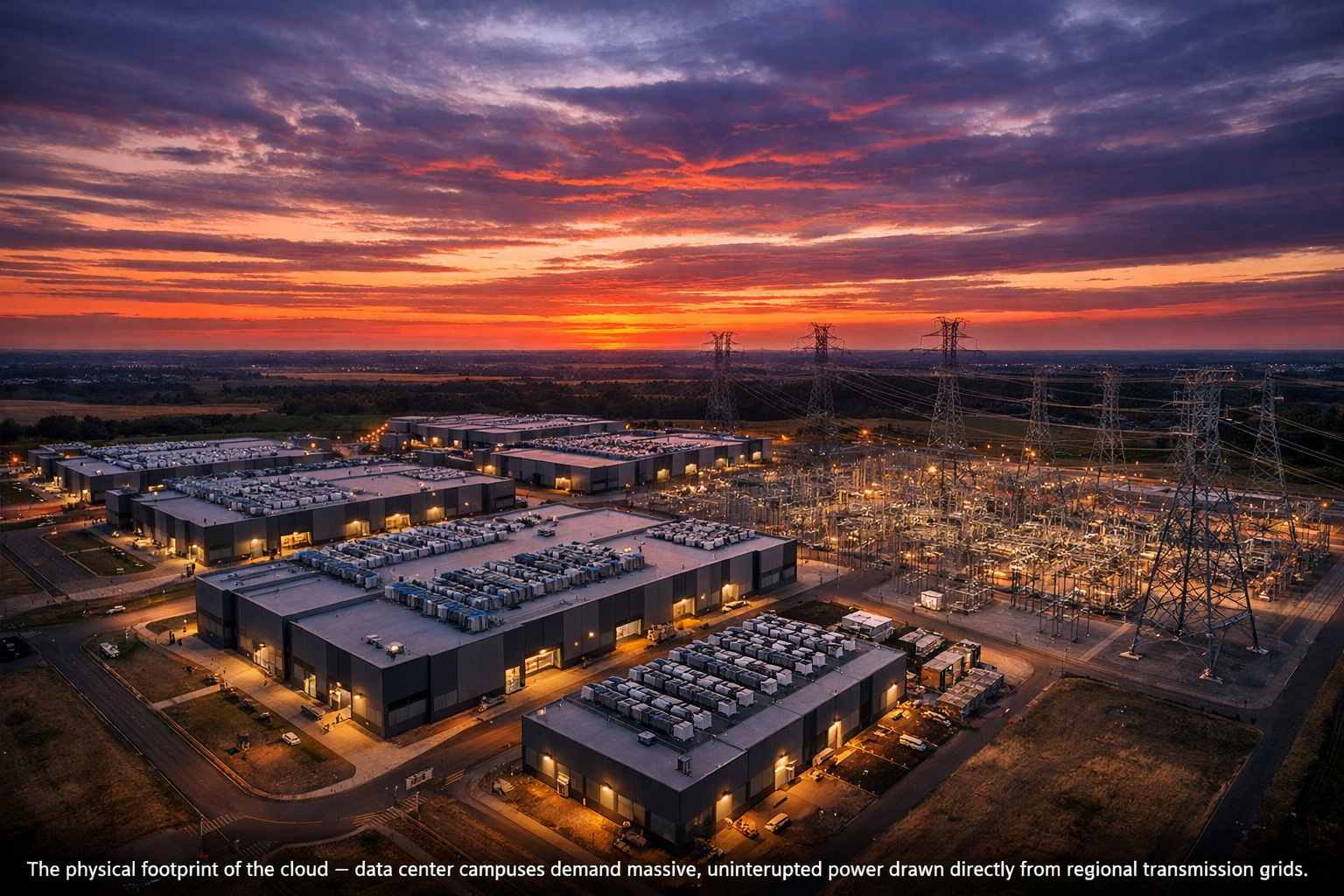
As demand for digital services accelerates, data centers are scaling rapidly. Facilities that once operated at 10 or 20 megawatts are now expanding to 50, 100, or even larger multi-building campuses. This growth introduces new challenges, particularly in thermal management. Every watt of consumed electricity ultimately becomes heat, and dissipating that heat efficiently is one of the most pressing constraints facing the industry.
The future of data center development will be shaped not only by electrical capacity, but by the ability to manage heat, secure land, and integrate with regional power grids. In this sense, the “cloud” is becoming increasingly grounded—tied to geography, infrastructure, and the physical limits of energy systems.
Far from being abstract, the digital world is built on a foundation of steel, copper, and concrete. Its continued expansion depends on precise engineering, careful planning, and a deep understanding of the physical forces at play. For developers, utilities, and infrastructure stakeholders, this represents both a challenge and an opportunity: to build the next generation of digital infrastructure in a way that is resilient, efficient, and scalable for decades to come.
Share this article
Follow us
Latest articles


National Land Developers, LLC
609 E. Baltimore Pike
Media, PA 19063
Map & Directions