
The Cloud Has a Weight Problem: How the AI Boom Is Cracking America’s Power Grid
The AI boom is not just a software story. It is a physical infrastructure crisis in the making -- one that is straining power grids, reshaping land markets, and forcing a generational reinvestment in America's energy backbone.
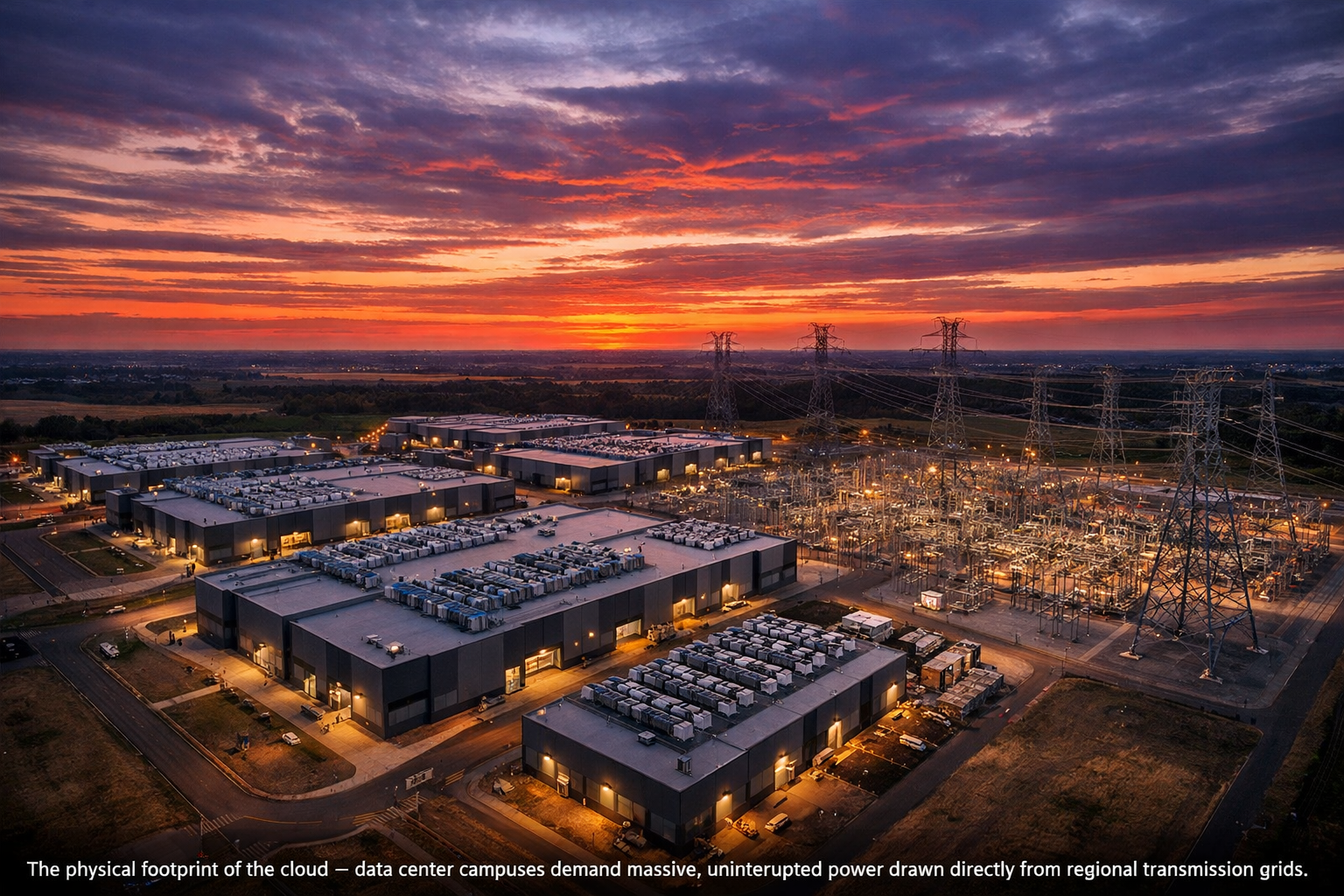
The word “cloud” is one of the most effective pieces of marketing ever conceived. It suggests something weightless, invisible, and effortless — a digital ether floating somewhere above us, available on demand. The physical reality could not be more different. The cloud is steel, concrete, copper wire, and electricity. Enormous amounts of electricity. And right now, the artificial intelligence boom is pushing that physical foundation toward a breaking point.
Drawing on research from CBRE’s Global Data Center Trends report, a landmark Goldman Sachs analysis of AI-driven power demand, and McKinsey’s assessment of global automation adoption, a clear picture emerges: the race for AI dominance is fundamentally a race for physical infrastructure — land, power, and grid capacity. For developers, investors, and site selectors, understanding that reality is no longer optional.
The Geography of the Cloud
Data centers are not distributed evenly across the globe. They cluster where power is reliable, land is accessible, and regulatory environments are cooperative. That concentration is becoming a serious constraint.
Northern Virginia remains the undisputed data center capital of the world, with 2.1 gigawatts of available supply. To put that number in context, a single gigawatt can power approximately 750,000 homes. Northern Virginia has more than two of them dedicated entirely to server infrastructure. Roughly 34% of that electricity comes from nuclear generation — a deliberate choice driven by the need for uninterrupted baseload power. Data centers do not sleep. They require a constant, massive draw, 24 hours a day, seven days a week.
Even with that robust foundation, vacancy rates in Northern Virginia are falling fast. The same is true across every major market globally. Singapore, the world’s most power-constrained data center market, has less than 4 megawatts of available capacity — a vacancy rate under 2%. The result is predictable: Singapore commands the highest rents in the world, between $300 and $450 per month per kilowatt of power requirement. Compare that to Chicago, currently one of the most affordable markets at $15 to $125 per kilowatt, and the economic pressure driving geographic expansion becomes obvious.
That pressure is reshaping the map. The Dallas-Fort Worth area recorded an 850% increase over its normal leasing activity, displacing Silicon Valley as North America’s second largest data center market. The driver is not just available land — it is Texas’s independent power grid, ERCOT, which operates largely within state borders and is insulated from the interstate transmission bottlenecks and federal regulatory delays that constrain other markets. Developers can move faster in Texas. They can negotiate power purchase agreements and bring facilities online in timeframes that are simply not achievable in most other regions. Internationally, Brazil saw its data center inventory grow 127% between 2020 and 2023, reflecting a global scramble for viable sites.
Why You Cannot Just Build More Warehouses
A common misconception in site selection circles is that data center development is primarily a real estate challenge. Build the shell, install the servers, flip the switch. In reality, the walls and the roof are the easy part. The bottleneck is power infrastructure.
A residential neighborhood’s power demand follows a predictable curve — morning spikes, midday lull, evening peak. Utilities have managed that curve for decades. A data center imposes something fundamentally different: a massive, unyielding baseline draw that does not fluctuate with time of day or season. Integrating that kind of load into an existing grid requires engineering solutions at every level — from local substations to regional transmission networks.
Cities around the world are beginning to confront that reality in concrete ways. Amsterdam imposed a moratorium on large-scale data center development after its infrastructure reached saturation. Frankfurt proposed regulations requiring new facilities to capture waste heat and pipe it to residential buildings — a technically complex and expensive mandate that signals just how strained local grids have become. These are not isolated cases. They reflect a systemic constraint that developers must evaluate at every potential site.
The AI Multiplier
For years, the growth in data center power demand was relatively contained. Chip efficiency improved at roughly the same rate that new internet users came online, keeping the overall curve flat. Generative AI broke that equation.
A standard Google search consumes a tiny fraction of a watt. A single query to a generative AI model consumes 6 to 10 times more power than a traditional search. The difference is architectural. A conventional search retrieves pre-indexed information — it is a lookup operation. A generative AI query produces entirely new output, performing real-time matrix calculations across billions of parameters. That active computation is what burns the electricity.
Multiply that 6x to 10x power differential across millions of users and billions of daily queries, and the math becomes staggering. Goldman Sachs projects a 15% annualized growth rate in data center power demand from 2023 through 2030.
Counterintuitively, improvements in chip efficiency are accelerating rather than moderating this trend. Nvidia’s DGX A100 system consumed a maximum of 6.5 kilowatts. Its successor, the DGX B200, consumes 14.3 kilowatts — more than double. But that B200 system delivers roughly 15 times the computing speed, dropping the power intensity per calculation from higher benchmarks down to 0.20 kilowatts per petaflop. The cost per computation has plummeted. And as economists have understood since the 19th century, when the cost of using a resource falls dramatically, total consumption of that resource rises. This is Jevons paradox in action. Tech companies are not using the efficiency gains to do the same work for less money. They are using them to do vastly more work.
A Grid That Was Not Built for This
Here is the critical context that most coverage of the AI infrastructure boom misses: the United States power grid has been operating in a zero-growth environment for roughly a decade. Between rising efficiency in lighting, appliances, and industrial motors, total US power demand grew at approximately 0% annually for the past ten years — even as millions of new devices and electric vehicles were added to the system.
Utilities built their long-range planning assumptions around that flat demand curve. Now those assumptions are obsolete. Goldman Sachs forecasts US power demand growth accelerating to a 2.4% annualized rate through 2030, driven primarily by data centers. Data centers currently consume approximately 3% of total US electricity. By 2030, Goldman projects that share will reach 8% — nearly tripling in less than a decade.
The strain on regional grids is already visible. Dominion Energy in Virginia, which serves the Northern Virginia data center corridor, recorded a 24% annualized growth rate in data center power demand between 2017 and 2023. In 2022, Dominion temporarily halted new connections — telling some of the most profitable technology companies on earth that they could not plug in their servers. The constraint was not generation capacity. It was transmission infrastructure: the high-voltage lines, substations, and transformers physically could not carry the additional load without risking regional grid stability. PJM, the regional transmission organization overseeing that grid, subsequently held a $5 billion transmission upgrade auction just to handle the existing backlog.
The Capital Required to Close the Gap
The scale of investment required to meet AI-driven power demand is comparable to the great infrastructure mobilizations of American history. Goldman Sachs estimates the US will need approximately 47 gigawatts of entirely new power generation capacity to accommodate projected data center growth — the equivalent of dozens of new power plants.
Based on grid reliability requirements, Goldman expects that new capacity to arrive in a roughly 60/40 split: 60% natural gas, 40% renewables. The math behind that split is straightforward. Wind and solar are intermittent. Data centers are not. Until battery storage technology scales sufficiently to bridge generation gaps, utilities must rely on dispatchable power — sources that can be activated on demand, regardless of weather conditions. Natural gas fills that role. The consequence is an estimated 3.3 billion cubic feet per day of new natural gas demand created directly by the AI buildout. The narrative that the digital economy is clean and the industrial economy is carbon-heavy is not accurate. They are deeply interconnected.
Beyond generation, the transmission and distribution infrastructure required to move that power represents an even larger investment. Goldman forecasts approximately $720 billion in grid spending — transmission lines, distribution networks, substation upgrades — through 2030. Add roughly $50 billion in generation capital expenditures, and the total infrastructure investment required to power the AI economy approaches $800 billion in the United States alone.
The Cascade Effect: What McKinsey’s Automation Data Reveals
The Goldman Sachs power projections are substantial on their own. But they do not fully capture the downstream force of what McKinsey’s automation research describes. Generative AI is not arriving into a static economy. It is arriving into an economy that was already undergoing broad automation adoption across manufacturing, financial services, logistics, and healthcare. Generative AI acts as an accelerant on that existing trend.
The cascade works as follows: a logistics company implements AI routing tools to stay competitive. That requires cloud compute. The cloud provider buys more servers. The server manufacturer needs more chips. The utility needs more generation capacity. The utility needs more transmission infrastructure. The copper supplier, the transformer manufacturer, the construction firm pouring substation concrete — all of them see demand increase. This is not a technology sector story. It is an economy-wide capital mobilization.
It also creates a self-reinforcing urgency. Companies that delay AI adoption risk competitive disadvantage. That fear of falling behind compresses decision timelines, accelerates capital deployment, and intensifies the pressure on physical infrastructure across the entire supply chain simultaneously.
The Physical World as the Ultimate Bottleneck
Goldman Sachs poses what may be the defining question of the next decade: will the growth of AI be constrained by consumer demand, by corporate capital budgets, or by neither? If demand for AI tools is effectively limitless and corporations are willing to absorb substantial losses to win the AI race, financial constraints disappear. What remains is physical constraint.
The supply chains for high-grade copper are finite. Specialized transformer manufacturing capacity cannot be scaled overnight. Natural gas pipeline permitting is a multi-year political process. Zoning approvals for large-scale power infrastructure remain contentious in jurisdictions from Frankfurt to Northern Virginia. The physical world — land, power, materials, and the regulatory frameworks governing them — becomes the ceiling on how fast the digital economy can grow.
Why This Matters for Land and Infrastructure Development
For developers and investors operating in the land and infrastructure space, the implications are significant and immediate.
Site selection criteria are evolving rapidly. Proximity to available grid capacity, substation access, and transmission infrastructure are now primary filters — not secondary considerations. Markets with independent or less-constrained grid structures, like Texas under ERCOT, carry a meaningful premium precisely because they can move at the speed the market demands.
The geographic reshuffling is ongoing. As primary markets saturate and secondary markets develop the infrastructure to compete, the window for early positioning in emerging corridors is open but narrowing. Brazil’s 127% inventory growth and the Dallas-Fort Worth surge are leading indicators, not outliers.
The capital cycle is long. The $720 billion in projected grid spending does not deploy in a single budget cycle. It flows through years of planning, permitting, engineering, and construction. Developers who understand where that capital is headed — and where the infrastructure gaps are largest — are positioned to identify sites before the market fully prices in their value.
The cloud is not weightless. It never was. It is a physical asset class, subject to the same constraints as any other heavy infrastructure — power availability, land access, transmission capacity, and regulatory environment. The AI boom has made those constraints visible in ways they have not been for a generation. For those operating at the intersection of land development and digital infrastructure, that visibility is an opportunity.

